
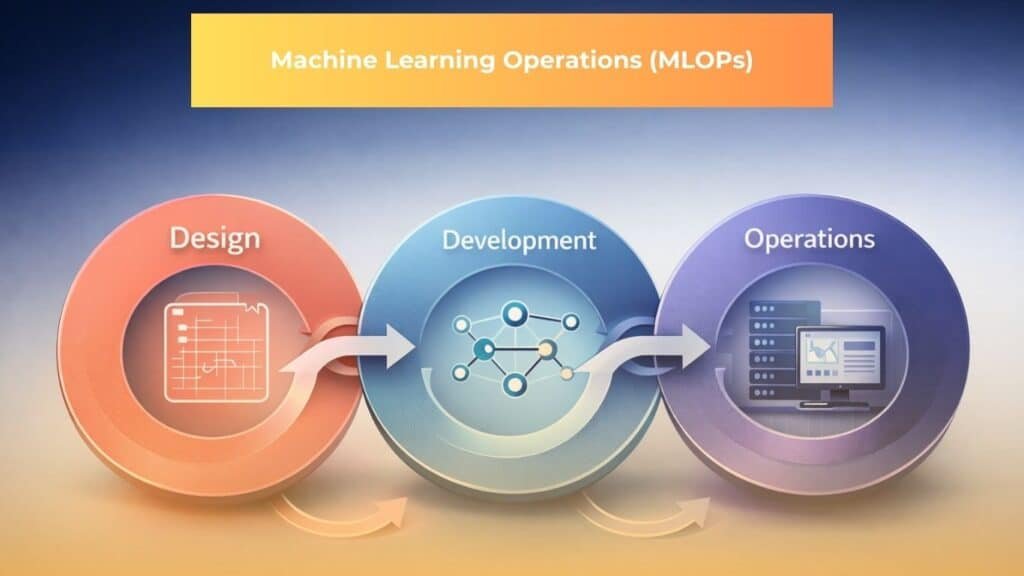
MLOps (Machine Learning Operations) is a set of practices, engineering culture, and tools that automates and streamlines the end-to-end Machine Learning (ML) lifecycle. It adapts traditional DevOps principles—continuous integration, deployment, and monitoring—to the unique challenges of machine learning models.
Where DevOps bridges the gap between software developers and IT operations, MLOps unifies Data Scientists, ML Engineers, and DevOps Teams to move models from experimental notebooks into reliable, continuous production systems.
Why Is MLOps Necessary? (The “Code vs. Data” Problem)
In traditional software development, code is deterministic: predictable inputs produce predictable outputs. In machine learning, system behavior depends on both Code + Data + Hyperparameters.
Building a model in a Jupyter notebook is only 15% of the total engineering effort. Managing data pipelines, retraining schedules, deployment infrastructure, and real-time model monitoring accounts for the remaining 85%.
┌───────────────────────────────────────────────────────────┐
│                    TRADITIONAL DEVOPS                     │
│               Code  ───►  Build  ───►  Deploy             │
└───────────────────────────────────────────────────────────┘
                                 │
                                 ▼
┌───────────────────────────────────────────────────────────┐
│                          MLOPS                            │
│    Data  ───►  Train Model  ───►  Evaluate  ───► Deploy   │
│     ▲                                              │      │
│     └────────────── Retrain on Drift ──────────────┘      │
└───────────────────────────────────────────────────────────┘
Without MLOps, organizations suffer from “hidden technical debt,” leading to models that perform exceptionally well in training but silently degrade in production due to changing real-world data.
Core Pillars of MLOps
| MLOps Component | What It Handles | Key Tools & Infrastructure |
| Data & Feature Engineering | Ingesting, cleaning, versioning raw data, and centralizing reusable variables for training/inference. | Feature Stores (Feast, Tecton), DVC, Delta Lake |
| Model CI/CD | Automating testing of code and data quality, orchestrating distributed training, and validating model metrics. | Kubeflow, Apache Airflow, GitHub Actions |
| Model Registry | Centralized repository tracking model versions, metadata, lineage, and approval status. | MLflow Registry, AWS SageMaker Registry |
| Continuous Deployment (CD) | Deploying models via REST/gRPC APIs, batch processing jobs, or edge device runtimes. | Triton Inference Server, TorchServe, KServe |
| Continuous Monitoring | Real-time tracking of infrastructure health, data drift, concept drift, and performance degradation. | Prometheus, Evidently AI, Arize AI, Grafana |
MLOps vs. Traditional DevOps
Understanding the key differences helps clarify why standard CI/CD tooling isn’t enough for machine learning workloads:
| Dimension | Traditional DevOps | MLOps |
| Core Artifact | Executable Code & Compiled Binaries | Code + Datasets + Model Weights |
| Testing Scope | Unit tests, Integration tests, System tests | Data validation, Model accuracy, Bias/Fairness tests |
| Deployment Trigger | Code commit or release tag | Code updates, Scheduled retraining, or Data Drift detection |
| System Decay | Code breaks due to bugs or OS changes | Models decay naturally over time as real-world trends shift |
| Team Profiles | Software Engineers, QA, System Admins | Data Scientists, ML Engineers, Data Engineers, SREs |
The Three Levels of MLOps Maturity
Google defines MLOps adoption across three developmental tiers:
-
Level 0 (Manual Process):
-
Data collection, model training, and deployment are done via manual scripts or interactive notebooks.
-
Disconnect between Data Scientists and Operations; releases take weeks or months.
-
Lack of continuous monitoring; models are rarely retrained until noticeable failures occur.
-
-
Level 1 (ML Pipeline Automation):
-
Continuous Training (CT) is established. Training pipelines are automated and triggered when new data arrives.
-
Data and model validation steps are embedded in the pipeline to prevent broken deployments.
-
Experimental code transitions smoothly into reproducible production jobs.
-
-
Level 2 (CI/CD Pipeline Automation):
-
Full automation of both code CI/CD and ML pipelines.
-
Automated testing and validation of new ML algorithms/architectures prior to production deployment.
-
Rapid, low-risk deployment of new model iterations with automated fallback mechanisms.
-
Key Challenges Solved by MLOps

-
Data & Concept Drift: When customer behavior changes or macro events occur, input data shifts (data drift) or the relationship between inputs and outputs breaks down (concept drift). MLOps platforms detect drift automatically and trigger pipeline retraining.
-
Reproducibility: Tracking exact historical training runs—including dataset versions, code commits, environment dependencies, and random seeds—ensures auditability and debugging compliance.
-
Governance and Compliance: Maintaining clear records of model lineage, fair representation, and access controls to adhere to strict AI regulatory standards.