
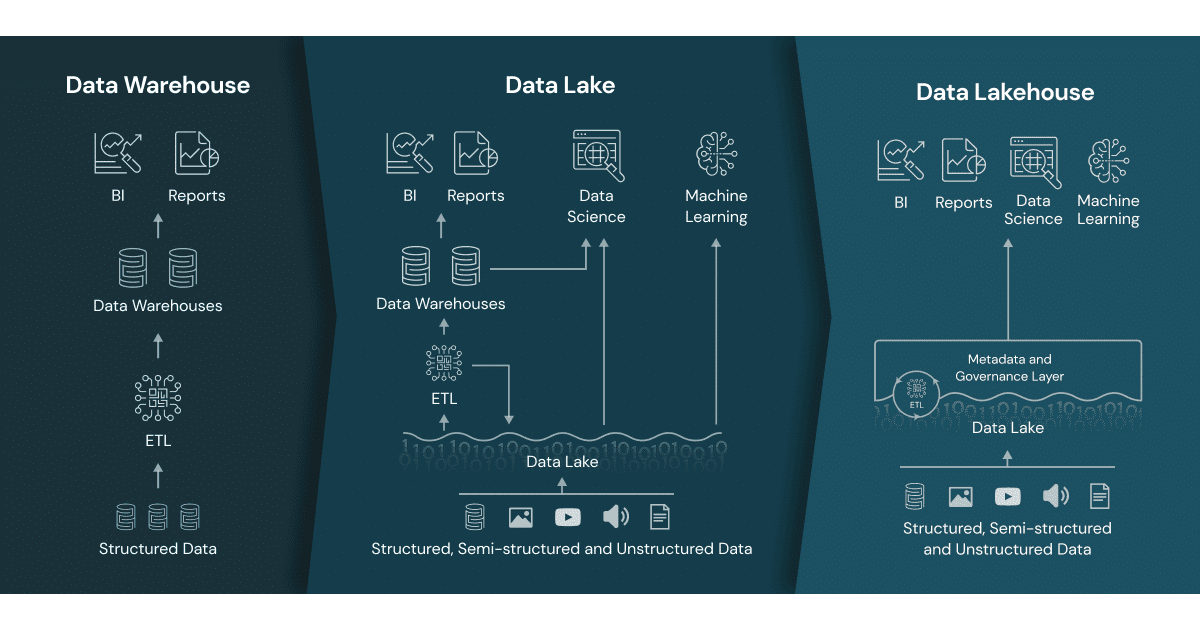
Modern data architecture has evolved significantly over the past three decades. Businesses initially relied exclusively on structured Data Warehouses to power business intelligence (BI) reports and SQL dashboards. As big data accelerated—driven by social media, IoT sensors, and unstructured clickstream logs—organizations adopted Data Lakes to store vast volumes of raw data cost-effectively.
Today, a hybrid paradigm called the Data Lakehouse has emerged, combining the reliability and ACID transaction guarantees of data warehouses with the open, scalable storage of data lakes.
1. Core Architectural Evolution
1. DATA WAREHOUSE (1990s-2000s)
   Structured Data ──► [ Schema-on-Write ] ──► Proprietary Storage + Compute Engine ──► BI & SQL

2. DATA LAKE (2010s)
   Unstructured / Raw Data ──► [ Schema-on-Read ] ──► Low-Cost Object Storage (S3/GCS) ──► ML & Data Science

3. DATA LAKEHOUSE (Modern)
   All Data Types ──► [ Open Metadata Layer (Delta/Iceberg) ] ──► Decoupled Storage/Compute ──► BI + ML + Streaming
2. High-Level Concept Breakdown
Data Warehouse: Structured Analytics Engine
A Data Warehouse is an enterprise data repository optimized for fast SQL queries and business analytics. It requires data to be cleaned, transformed, and structured into fixed relational schemas before loading (Schema-on-Write via ETL pipelines).
-
Primary Storage: High-performance, often proprietary storage formats.
-
Best For: Business Intelligence (BI), executive dashboards, historical reporting, and SQL analytics.
-
Examples: Snowflake, Google BigQuery, Amazon Redshift.
Data Lake: Mass Raw Storage Repository
A Data Lake is a centralized storage repository that holds vast quantities of raw data in its native format (structured, semi-structured, and unstructured) until it is needed (Schema-on-Read via ELT pipelines).
-
Primary Storage: Low-cost cloud object storage (Amazon S3, Google Cloud Storage, Azure Blob).
-
Best For: Machine learning model training, big data exploration, storing raw unstructured logs, and data science research.
-
Examples: Apache Hadoop (HDFS), AWS Lake Formation, Databricks Delta Lake (Storage Layer).
Data Lakehouse: The Unified Hybrid Architecture
A Data Lakehouse is an open architecture that implements a metadata and transaction layer directly on top of low-cost cloud object storage. It brings warehouse-like ACID transactions, data versioning (time-travel), and schema enforcement directly to the raw files stored in the data lake.
-
Primary Storage: Open storage table formats (Apache Iceberg, Delta Lake, Apache Hudi) on top of S3/GCS.
-
Best For: Unifying BI dashboards, real-time streaming, and machine learning pipelines under a single security and governance engine.
-
Examples: Databricks Lakehouse, Dremio, Apache Iceberg + Snowflake/Trino.
3. Side-by-Side Comparison
| Architectural Attribute | Data Warehouse | Data Lake | Data Lakehouse |
| Supported Data Types | Structured data only | Structured, semi-structured, unstructured | Structured, semi-structured, unstructured |
| Schema Paradigm | Schema-on-Write (Strict schema enforcement on ingest) | Schema-on-Read (Schema applied when querying) | Schema-on-Write & Read (Enforced governance with flexibility) |
| Storage & Compute | Tightly coupled or proprietary separation | Completely decoupled, low-cost object storage | Decoupled compute with low-cost open object storage |
| Transaction Guarantees | Full ACID compliance | Minimal or none (risks concurrent write conflicts) | Full ACID compliance via transaction log layers |
| Performance Speed | Fast for structured SQL queries | Slower for SQL queries; optimized for bulk scans | Fast for SQL queries (via caching & indexing) and ML |
| Primary End Users | BI Analysts, Data Engineers, Executives | Data Scientists, ML Engineers, Big Data Developers | Data Scientists, BI Analysts, Data Engineers (Unified) |
| Cost Efficiency | Higher storage cost per gigabyte | Extremely low storage cost | Low storage cost with scalable compute |
4. How the Lakehouse Solves the “Two-Tier Architecture” Problem
Before the lakehouse model, enterprises were forced to maintain a complex two-tier data architecture: raw data entered a Data Lake for ML processing, and a subset was extracted, transformed, and copied into a Data Warehouse for BI reporting.
OLD TWO-TIER ARCHITECTURE (High Complexity & Data Duplication):
Raw Data ──► [ Data Lake ] ──► (ML & Data Science)
                   │
           (Fragile ETL Sync)
                   ▼
             [ Data Warehouse ] ──► (BI & SQL Dashboards)

UNIFIED LAKEHOUSE ARCHITECTURE (Single Source of Truth):
Raw Data ──► [ Open Storage Layer (Parquet/ORC) ]
                   │
             [ Transaction & Governance Layer (Delta / Iceberg) ]
                   │
                   ├──► Machine Learning & Data Science (PySpark / PyTorch)
                   └──► BI & SQL Dashboards (Trino / Spark SQL / Tableau)
This traditional dual approach caused severe operational pain points:
-
Stale Data & ETL Pipelines: Constant copying between lake and warehouse created latency and fragile pipeline dependencies.
-
Data Inconsistency: Inconsistent calculations between ML models (reading from the lake) and executive dashboards (reading from the warehouse).
-
Governance Overhead: Managing separate access control, masking, and security rules across two distinct data stores.
The Data Lakehouse eliminates the middleman by running high-speed query engines directly on open table formats (like Apache Iceberg or Delta Lake), serving BI and ML from a single, unified source of truth.
Key Takeaway

-
Data Warehouses excel at high-speed structured SQL queries and business intelligence.
-
Data Lakes excel at storing massive volumes of raw, unstructured data for data science at low cost.
-
Data Lakehouses offer the best of both worlds—bringing ACID transactions, schema enforcement, and fast SQL performance directly to low-cost cloud storage to power BI, streaming, and Machine Learning on one unified platform.