
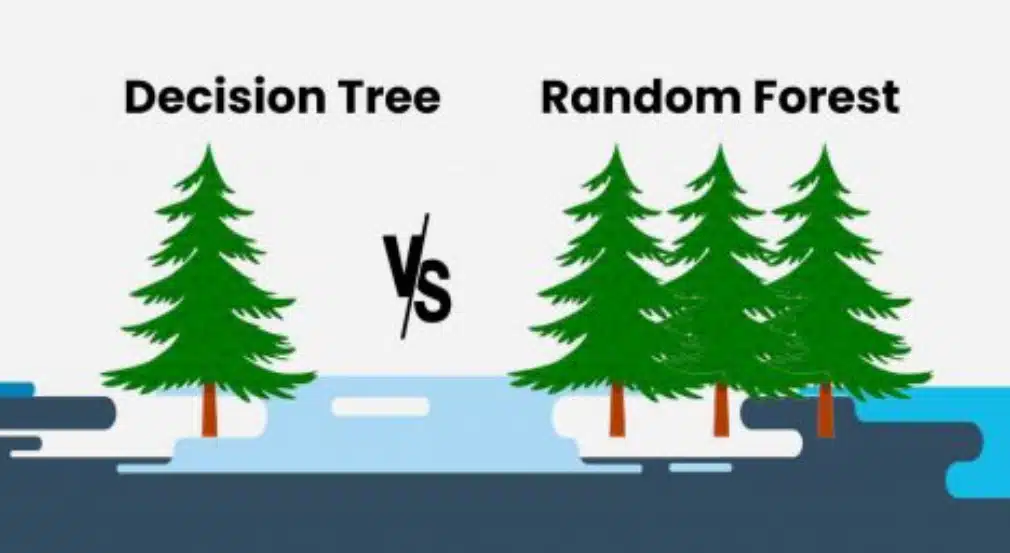
Tree-based algorithms are among the most popular, versatile, and intuitive tools in machine learning. Whether you are classifying churned customers, predicting house prices, or analyzing medical risk factors, tree algorithms offer high predictive power with relatively straightforward setups.
When starting with tree-based models, two core techniques stand out: Decision Trees and Random Forests. While both share the same fundamental logic, they differ dramatically in how they build decisions, handle complex patterns, and generalize to new data.
Here is an easy-to-understand breakdown of how both algorithms work, how they compare, and when to choose one over the other.
What is a Decision Tree?
A Decision Tree is a non-parametric supervised learning model that splits data into progressively smaller, more homogeneous subsets based on conditional rules (“if-then” questions).
Think of a Decision Tree as a flowchart. You start at the top (Root Node), test a feature condition, follow the branch based on the answer, and repeat the process through internal decision points (Internal Nodes) until you reach a final answer (Leaf Node).
                            [ Income > $50,000? ]  (Root Node)
                               /            \
                             Yes             No
                             /                \
                 [ Age > 30? ]             [ Approve Loan: No ]  (Leaf Node)
                   /       \
                 Yes        No
                 /            \
   [ Approve: Yes ]          [ Approve: No ]  (Leaf Nodes)
Key Strengths
-
High Interpretability: Easy to visualize, explain to stakeholders, and convert into simple business rules.
-
Minimal Preprocessing Needed: Handles both categorical and numerical features naturally without requiring scale-normalization or dummy encoding.
Major Weakness: Overfitting
A single Decision Tree left unchecked will keep splitting until every single training observation is perfectly isolated into its own leaf node. This produces a model with high variance that memorizes noise in the training set and generalizes poorly to unseen test data.
What is a Random Forest?
A Random Forest is an ensemble learning algorithm designed specifically to fix the overfitting problem of single Decision Trees.
Instead of relying on one tree to make a prediction, a Random Forest builds a “forest” of hundreds of diverse Decision Trees and combines their outputs—using majority voting for classification problems or averaging for regression problems.
                         Input Data (Unseen Example)
                                     │
           ┌─────────────────────────┼─────────────────────────┐
           ▼                         ▼                         ▼
   [ Decision Tree 1 ]       [ Decision Tree 2 ]       [ Decision Tree N ]
           │                         │                         │
      Predicts: Yes             Predicts: Yes              Predicts: No
           │                         │                         │
           └─────────────────────────┼─────────────────────────┘
                                     ▼
                            [ Majority Voting ]
                                     │
                                     ▼
                           Final Prediction: YES
The Magic: Bagging & Random Feature Subsets
How does a Random Forest make its individual trees diverse enough so they don’t all make the same mistakes? It relies on two key randomness mechanisms:
-
Bootstrap Aggregating (Bagging): Each tree in the forest is trained on a distinct, randomly sampled subset of the original data (drawn with replacement).
-
Random Subspace Method: At every single node split, the algorithm evaluates only a random subset of features (e.g., $\sqrt{p}$ features) rather than all available variables. This prevents single dominant features from driving every tree in the ensemble.
By combining the predictions of hundreds of slightly different, uncorrelated trees, the Random Forest cancels out individual errors, producing a robust model with significantly lower variance.
Head-to-Head Comparison
| Feature / Metric | Decision Tree | Random Forest |
| Model Type | Single Base Estimator | Ensemble (Collection of Trees) |
| Variance / Overfitting Risk | High (Prone to memorizing training noise) | Low (Averaging reduces model variance) |
| Interpretability | High (Easily visualizable tree diagram) | Low (Black-box ensemble of 100+ trees) |
| Training & Prediction Speed | Fast (Trains a single structure) | Slower (Trains many trees in parallel) |
| Out-of-the-Box Accuracy | Moderate | High (Strong baseline performance) |
| Sensitivity to Outliers | High (Single split changes entire downstream tree) | Low (Outliers are diluted across trees) |
Real-World Scenario: When to Use Which?
                        Choosing Your Model
                                 │
         ┌───────────────────────┴───────────────────────┐
         ▼                                               ▼
[ Choose Decision Tree ]                       [ Choose Random Forest ]
• Needs simple, visual flowchart explanations   • Priority is maximum prediction accuracy
• Strict regulatory compliance requires auditing • Large tabular datasets with complex noise
• Real-time edge devices with low latency        • High-dimensional feature spaces
Choose a Decision Tree when:
-
Explainability is mandatory: You work in highly regulated sectors like banking or insurance where every model decision must be audited and explained in plain language.
-
Resource-constrained environments: You need a light, ultra-fast model that executes instantaneously on mobile or edge devices.
-
Quick baseline exploration: You want to quickly identify which features drive key initial splits during exploratory analysis.
Choose a Random Forest when:
-
Accuracy and stability are top priorities: You want state-of-the-art predictive performance on complex tabular data without spending hours hyperparameter tuning.
-
Large datasets with high dimensionality: Your data contains hundreds of input features, continuous measurements, and noise.
-
Preventing overfitting is critical: You need a model that generalizes reliably to real-world production distributions.
Key Takeaway
Think of a Decision Tree as consulting a single expert—they might be fast and logical, but their personal biases can lead to bad advice. A Random Forest is like polling a diverse committee of hundreds of experts—while it takes a bit more time to tally their votes and hard to explain every individual thought process, the wisdom of the crowd yields far more reliable results.