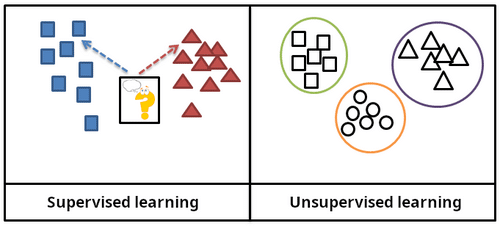
Machine learning models fall primarily into two foundational paradigms: Supervised Learning and Unsupervised Learning. Choosing the correct approach dictates how your algorithms process inputs, learn patterns, and generate predictions in production.Understanding the core mechanics, data requirements, and ideal use cases for both paradigms is essential for any data science or machine learning practitioner.
What is Supervised Learning?
Supervised learning algorithms are trained using labeled datasets. This means every input data point comes paired with a known, correct target output label. The algorithm learns by mapping the relationship between input features ($X$) and outputs ($Y$), iteratively adjusting its parameters to minimize prediction errors.
Input Features (X) ──► Model Training (Guided by Ground Truth Y) ──► Output Prediction (Y)
During training, a loss function calculates the difference between the model’s prediction and the actual ground-truth label. Optimization algorithms (like Gradient Descent) then tweak the model’s weights to increase accuracy over time.
Primary Subcategories
-
Classification: Predicts discrete, categorical target outcomes.
-
Examples: Predicting if an email is
SpamorNot Spam, or diagnosing whether a medical scan indicates aBenignorMalignanttumor.
-
-
Regression: Predicts continuous, numerical values.
-
Examples: Forecasting home market values, estimating stock prices, or predicting customer lifetime value (CLV).
-
Popular Supervised Algorithms
-
Linear and Logistic Regression
-
Decision Trees and Random Forests
-
Support Vector Machines (SVM)
-
Gradient Boosting Frameworks (XGBoost, LightGBM)
-
Neural Networks / Deep Learning (when trained on labeled outputs)
What is Unsupervised Learning?
Unsupervised learning works with unlabeled data. Instead of learning from known target outputs, the algorithm explores the input features to discover hidden structures, natural groupings, or underlying patterns on its own without human guidance.
Unlabeled Input Features (X) ──► Model Pattern Discovery ──► Clusters / Dimension Reductions
Because there are no ground-truth labels, unsupervised models do not calculate traditional “prediction accuracy.” Instead, they evaluate internal mathematical metrics—such as cluster density, inter-cluster distance, or variance preserved.
Primary Subcategories
-
Clustering: Grouping similar data points together based on feature proximity or density without prior category labels.
-
Dimensionality Reduction: Compressing complex, high-dimensional datasets into fewer features while preserving essential variance and relationships.
-
Association Rule Learning: Uncovering interesting relationships or conditional dependencies between variables in large transaction databases.
Popular Unsupervised Algorithms
-
$K$-Means and Hierarchical Clustering
-
DBSCAN (Density-Based Spatial Clustering)
-
Principal Component Analysis (PCA)
-
Singular Value Decomposition (SVD)
-
Apriori and FP-Growth Algorithms
-
Autoencoders (Deep Learning)
Direct Comparison: Supervised vs. Unsupervised
| Feature | Supervised Learning | Unsupervised Learning |
| Input Data | Labeled dataset ($X$ and target $Y$) | Unlabeled dataset ($X$ only) |
| Primary Goal | Predict outcomes for unseen future data | Discover hidden patterns, structures, or anomalies |
| Human Effort | High (Requires manual data labeling & curation) | Low (Self-guided feature discovery) |
| Evaluation Metric | Clear: Accuracy, Precision, Recall, MSE, $R^2$ | Subjective/Heuristic: Silhouette Score, Inertia, Explained Variance |
| Complexity | Conceptually direct; computational focus | Mathematically complex; open-ended interpretation |
| Feedback Loop | Direct feedback (compares prediction to actual) | No feedback loop (no ground truth available) |
Real-World Applications Side-by-Side
To see how these two paradigms operate across industries:
                          Industry Applications
                                    │
       ┌────────────────────────────┴────────────────────────────┐
       ▼                                                         ▼
[ Supervised Applications ]                               [ Unsupervised Applications ]
• Fraud Detection (Binary Classification)                  • Customer Segmentation (K-Means)
• Loan Default Risk (Logistic Regression)                 • Anomaly Detection (Isolation Forests)
• Medical Diagnostics (CNN Image Analysis)                 • Market Basket Analysis (Apriori Rules)
1. Finance & Banking
-
Supervised: Credit scoring systems analyze historical applicant data ($X$) and past loan default statuses ($Y$) to predict new applicant risk.
-
Unsupervised: Anomaly detection algorithms analyze real-time credit card transactions to flag irregular spending patterns without prior fraud labels.
2. E-Commerce & Retail
-
Supervised: Sales forecasting models predict next quarter’s revenue based on past seasonal demand metrics.
-
Unsupervised: Customer segmentation groups millions of shoppers into distinct behavioral personas based on browsing history and cart activity.
3. Healthcare & Life Sciences

-
Supervised: Medical imaging algorithms detect lung nodules on X-rays by training on thousands of expert-annotated scans.
-
Unsupervised: Genomic clustering groups patients with similar gene expression profiles to discover previously unknown subtypes of diseases.
How to Choose the Right Approach
When starting a new data science project, ask yourself these three deciding questions:
-
Do you have reliable labeled target data?
-
Yes: Choose Supervised Learning.
-
No: Proceed to Question 2.
-
-
Is your goal to predict a specific target or explore data structure?
-
Predict: Invest in labeling a subset of data for Supervised Learning, or use Semi-Supervised Learning.
-
Explore: Choose Unsupervised Learning.
-
-
Are you trying to reduce feature noise or compress data dimensions?
-
Yes: Apply Unsupervised Learning (e.g., PCA) as a preprocessing step before training a supervised model.
-
Pro Tip: In modern enterprise production systems, these paradigms often work together. For instance, Semi-Supervised Learning uses a small set of labeled data alongside vast unlabeled datasets, while pipeline architectures often use unsupervised dimension reduction (like PCA) directly before a supervised classifier.
Key Takeaway
Supervised learning excels at targeted prediction tasks where ground-truth answers exist, but it demands costly data labeling. Unsupervised learning excels at exploratory analysis and discovering hidden patterns in raw data without human intervention. Mastering both equips you to tackle the complete spectrum of real-world data science problems.