
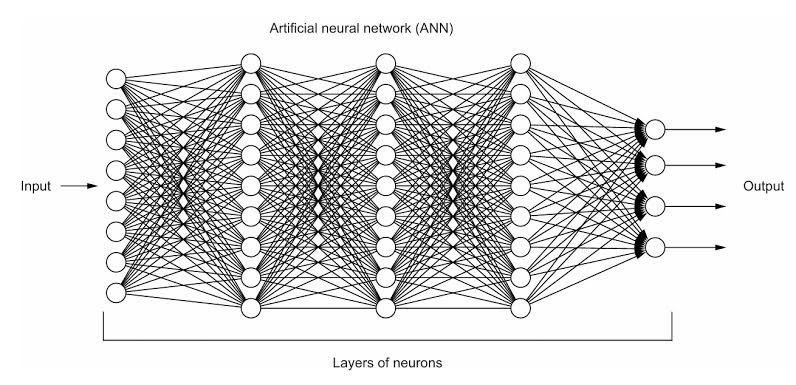
From self-driving vehicles and automated medical diagnostics to large language models like ChatGPT, Deep Learning is driving the modern artificial intelligence revolution.
At the core of almost all deep learning innovations lies a specific class of algorithms: Artificial Neural Networks (ANNs). Inspired loosely by the biological structure of the human brain, neural networks excel at detecting intricate patterns, structures, and relationships within unstructured data like images, audio, and raw text.
Here is a foundational breakdown of how neural networks function from the ground up.
1. What is an Artificial Neural Network?
An Artificial Neural Network is a computational model composed of interconnected processing units called nodes or neurons.
   Input Layer               Hidden Layer              Output Layer
  ┌───────────┐             ┌───────────┐             ┌───────────┐
  │  x₁ (Age) ┼────────────►│  Neuron 1 ┼────────────►│           │
  └───────────┘ \         / └───────────┘ \           │           │
                 \       /                 \          │ Predicted │
  ┌───────────┐   \     /   ┌───────────┐   \         │ Outcome   │
  │  x₂ (Inc) ┼────\───/───►│  Neuron 2 ┼────\───────►│    (ŷ)    │
  └───────────┘     \ /     └───────────┘     \       │           │
                     X                         \      │           │
  ┌───────────┐     / \     ┌───────────┐       \     │           │
  │  x₃ (Exp) ┼────/───\───►│  Neuron 3 ┼────────────►│           │
  └───────────┘   /     \   └───────────┘             └───────────┘
A standard Feedforward Neural Network consists of three structural layer types:
-
Input Layer: Receives raw input features ($x_1, x_2, \dots, x_n$) such as pixel values, tabular metrics, or word embeddings.
-
Hidden Layer(s): Intermediate layers where feature transformations take place. Networks with multiple hidden layers are called Deep Neural Networks.
-
Output Layer: Generates the final prediction ($\hat{y}$), such as a class label probability or a continuous numeric score.
2. Anatomy of an Artificial Neuron (Perceptron)
To understand how deep networks process information, we must look inside a single artificial neuron.
Inputs (x)      Weights (w)
  x₁ ────────────► [w₁] ──────┐
                              ▼
  x₂ ────────────► [w₂] ───► ( Weighted Sum: ∑(wᵢxᵢ) + b ) ──► [ Activation f(z) ] ──► Output (a)
                              ▲
  x₃ ────────────► [w₃] ──────┘
                              ▲
Bias ────────────► [ b ] ─────┘
A single neuron performs three sequential mathematical operations:
Step A: Weighted Linear Combination
Each input feature ($x_i$) is multiplied by an adjustable weight parameter ($w_i$). A bias term ($b$) is added to allow the activation threshold to shift independently of inputs:
$$z = \sum_{i=1}^{n} (w_i x_i) + b = w_1 x_1 + w_2 x_2 + \dots + w_n x_n + b$$
-
Weights ($w$): Control the strength/importance of each input signal.
-
Bias ($b$): Serves as an offset to shift the activation function left or right.
Step B: Non-Linear Activation Function
The scalar value $z$ is passed through a non-linear activation function, $f(z)$, to produce the neuron’s final output signal ($a = f(z)$).
Without activation functions, even a deep neural network with 100 hidden layers would behave like a simple linear regression model, incapable of learning complex non-linear patterns.
3. Key Activation Functions
| Activation Function | Formula | Output Range | Best Used For |
| ReLU (Rectified Linear Unit) | $f(z) = \max(0, z)$ | $[0, +\infty)$ | Standard default for hidden layers in modern deep networks. Fast to compute. |
| Sigmoid | $f(z) = \frac{1}{1 + e^{-z}}$ | $(0, 1)$ | Output layer for binary classification tasks. |
| Softmax | $f(z_i) = \frac{e^{z_i}}{\sum e^{z_j}}$ | $(0, 1)$ (sum = 1) | Output layer for multi-class classification probabilities. |
| Tanh (Hyperbolic Tangent) | $f(z) = \frac{e^z – e^{-z}}{e^z + e^{-z}}$ | $(-1, 1)$ | Zero-centered hidden layers in specialized architectures. |
4. How Neural Networks Learn: The Training Cycle
Training a neural network is an ongoing trial-and-error optimization loop executed across four main phases:
┌─────────────────────────┐
│ 1. Forward Propagation  │ (Generate Prediction ŷ)
└────────────┬────────────┘
             │
             ▼
┌─────────────────────────┐
│ 2. Calculate Loss J(w)  │ (Measure Prediction Error)
└────────────┬────────────┘
             │
             ▼
┌─────────────────────────┐
│  3. Backpropagation     │ (Compute Gradients via Chain Rule)
└────────────┬────────────┘
             │
             ▼
┌─────────────────────────┐
│  4. Optimizer Update    │ (Adjust Weights via Gradient Descent)
└────────────┬────────────┘
             │
             └───────────► Loop until loss is minimized
1. Forward Propagation
Data flows strictly forward from the input layer, through the hidden layers, to the output layer to produce a prediction ($\hat{y}$).
2. Loss Calculation
A Loss Function measures the difference between prediction ($\hat{y}$) and true target label ($y$). Common loss functions include Mean Squared Error (MSE) for regression and Cross-Entropy Loss for classification.
3. Backpropagation
Using the calculus Chain Rule, backpropagation works backward from the output layer to calculate the partial derivative (gradient) of the loss function with respect to every weight and bias parameter in the network:
$$\frac{\partial \text{Loss}}{\partial w_i}$$
4. Parameter Update (Optimization)
An optimization algorithm (like Adam or Stochastic Gradient Descent) uses the calculated gradients to update the network’s weights in the direction that decreases total loss:
$$w_{\text{new}} = w_{\text{old}} – \alpha \cdot \frac{\partial \text{Loss}}{\partial w}$$
This cycle repeats over thousands of training iterations (epochs) until loss converges to a minimum.
5. Major Deep Learning Architectures
While simple Feedforward Neural Networks work well on structured tabular data, specialized architectures handle specialized formats:
                           Deep Learning Architecture Types
                                          │
            ┌─────────────────────────────┼─────────────────────────────┐
            ▼                             ▼                             ▼
  [ CNNs (Convolutional) ]       [ RNNs & LSTMs ]              [ Transformers ]
  • Grid data (Images/Video)     • Sequential / Time-Series    • Attention-based model
  • Spatial feature extraction   • Historical context memory   • Industry default for LLMs / NLP
-
Convolutional Neural Networks (CNNs): Use specialized spatial filters to process image grid structures for visual tasks (e.g., object detection, facial recognition).
-
Recurrent Neural Networks (RNNs / LSTMs): Feature internal loops to retain historical context over sequential data streams like audio or time-series metrics.
-
Transformers: Rely on self-attention mechanisms to process sequential data in parallel. Transformers form the underlying architecture for state-of-the-art Natural Language Processing (NLP) models.
Key Takeaway
Deep neural networks derive their power from stacking simple artificial neurons into deep, non-linear processing hierarchies. Through forward propagation and backpropagation, networks automatically learn abstract feature representations from raw data without manual feature engineering.